Too small for fries: drought shrinks Belgian potatoes / Photo: JOHN THYS - AFP
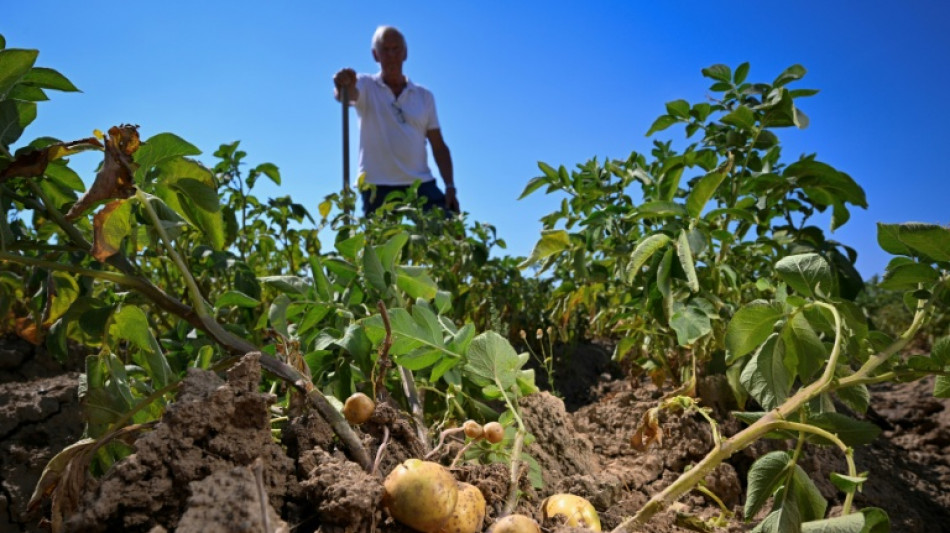
Mathieu Comijn inspected rows of potatoes in a field of cracked earth and browned leaves, pulling from the ground tubers barely the size of ping-pong balls.
"How do you expect to make fries out of these?" asked the Belgian farmer in frustration, as he uprooted another plant and examined it.
"Normally, they should be at least four times this size," he said.
Like many Belgian farmers this summer, Comijn's harvest in Amay, near the eastern city of Liege, has been hit by a devastating combination of weather extremes.
First, a spate of heavy rain and storms at the end of spring weakened the soil. Then, as elsewhere in Europe, exceptionally hot and dry conditions followed -- blamed by scientists on man-made climate change.
That caused the soil to harden into compact clumps in which potatoes "cannot breathe properly" and struggle to grow, the farmer explained.
"It's a disaster," the 30-year-old told AFP. "I've never seen anything like it."
The problem for Comijn is that all these rows of Bintje potatoes, a prized variety in Belgium, were destined to become long, golden fries -- a beloved staple in a country dotted by "friteries" or "frituren", street stalls specialising in the stuff.
Yet with just a month to go before the harvest, set for around September 20, none are larger than the palm of his hand. The only silver lining is that their flavour has not been spoiled by their diminished size.
- 'Too painful' -
Comijn's father Stephane has been so distressed by the situation that he refused to visit the field for several days.
"It's too painful," said the septuagenarian, wiping his forehead. The former head of the family farm struggles to remember weather this dry in the region -- except, perhaps, during a historic heatwave in 1976.
But good harvest or bad, the Comijn family, who grow 500 hectares (1,236 acres) of potatoes, still have supply contracts to meet.
As the world's top exporter of frozen fries, Belgium applies strict rules to its potato trade.
Before the harvest, growers and processors negotiate both delivery volumes and prices.
To help fulfil part of their commitments, the Comijns will draw on stocks from last year, when the harvest was exceptionally abundant.
"We had started throwing some of them away," Stephane Comijn explained, to make space for this year's crop.
"But now they're worth money," he said, standing in front of a refrigerated warehouse kept at 10C, where mountains of 2025 potatoes remain in storage.
- Supply crunch -
But Stephane Comijn knows using last year's stocks will not be enough.
"We're going to have to use varieties that aren't as good," he lamented. "People at the fry shops complain. You can explain to them that it's because of the drought, but they don't understand."
Bernard Lefevre, the president of the national union of fry vendors, sought to put things into perspective.
"There's always a problem," said Lefevre, who has worked in the sector for a quarter-century.
"Either there are too many potatoes, like last year, and prices collapse, so producers say it's a catastrophe, or it's the opposite extreme.
"And yet, year after year, we manage to get through it."
But with supplies under pressure, fry prices are likely to heat up too -- and for Lefevre, who represents 4,500 fry shops across Belgium, that is no small matter.
"Aside from illness in the royal family, the second worst piece of news a Belgian can hear is that the price of a cone of fries is going up," he told AFP.
W.Subaie--al-Hayat