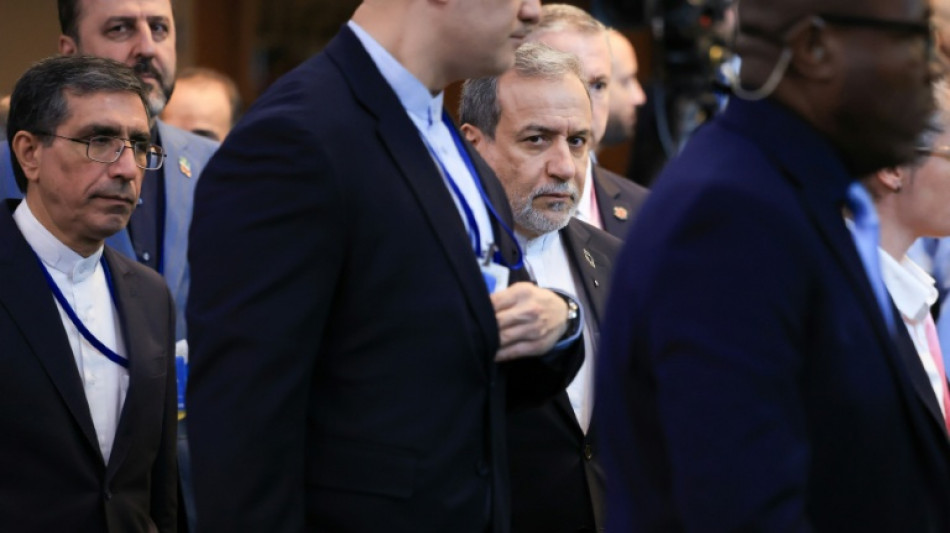
Iran stands firm on Hormuz plan after US rejection / Photo: CHARLY TRIBALLEAU - AFP
Iran stood firm Sunday on its conditions for reopening the Strait of Hormuz, despite US President Donald Trump's rejection of the proposal that had created some optimism for breaking the Mideast war stalemate.
The waterway is key to the world's energy supply and is now central to the conflict between Washington and Tehran, which was triggered nearly seven months ago with deadly strikes on Iran.
Iran's plan called for a cessation of all hostilities in the Middle East, including in Lebanon, according to Foreign Minister Abbas Araghchi, and fulfilling conditions in the ceasefire deal that fell apart months ago.
That agreement, which dissolved during fighting over Hormuz, called for the release of frozen Iranian assets, the lifting of sanctions on Iranian oil and an end to the US naval blockade.
"Our conditions are clear, and any move toward reopening the Strait of Hormuz is contingent upon these conditions being fulfilled. We will not back down from them," Araghchi said on Sunday, state broadcaster IRIB reported.
"We have never closed the door to diplomacy or negotiations, but at the same time, we have never backed down from our rights."
But Trump said on Saturday that he rejected the truce deal.
"They want to make a deal where they open the Strait immediately because they're losing so badly," he told reporters. "They want to make a deal and I think that's fine. I like making a deal too."
Araghchi said on Sunday that the Iranians "saw the first reaction from the US president, but so far, nothing has been conveyed to us by the mediators".
"We are waiting for the mediators to convey the definitive positions to us, and we will make a decision based on them," the foreign minister added.
- 'Tool for pressure' -
Washington and Tehran signed a memorandum of understanding in June that aimed to end the war, to reopen the strait and to launch talks on Iran's nuclear programme.
But the deal broke down shortly afterwards when Iran fired on commercial ships in Hormuz that it accused of deviating from its approved route through the waterway.
Iran requires ships to obtain authorisation before passage, citing security and sovereignty reasons.
Ships that refuse to comply are regularly targeted, while the United States sporadically bombs Iranian coastal areas in retaliation.
At the UN, Saudi Arabia's Foreign Minister Faisal bin Farhan complained that the "international community has been absent" and is failing to live up to the responsibility to keep the Strait of Hormuz and the Bab al-Mandab open.
"The kingdom rejects any party's use of these vital passages as a tool for pressure, threat, or harm to the interests of states," he said, stressing the waterways' importance to global energy security.
His Russian counterpart, Sergei Lavrov, told member states that "Russia, together with other responsible states, stands ready to constructively contribute to stabilising this strategically important region."
In New York, Iranian President Masoud Pezeshkian met with UN Secretary-General Antonio Guterres, according to his office, and said: "Iran has not walked away from the negotiating table but, given past experiences, it no longer trusts the United States."
Araghchi said at the UN: "Iran has conveyed to the United States, through Qatar, a concrete seven-day plan. If the necessary conditions are met, the strait can be reopened, and normal maritime passage restored within seven days."
"The choice now rests with the United States. Iran does not accept coercion, threats or intimidation, and Iran will not surrender its sovereign rights under pressure," he added.
Hossein Mohebi, a spokesman for Iran's Revolutionary Guards, was quoted by Tasnim news agency as saying: "We will not cease punishing the US until Iran's seven conditions are met."
Mohebi had told AFP in an exclusive interview on Tuesday that ending hostilities in Yemen was also among Tehran's demands.
H.Humaid--al-Hayat