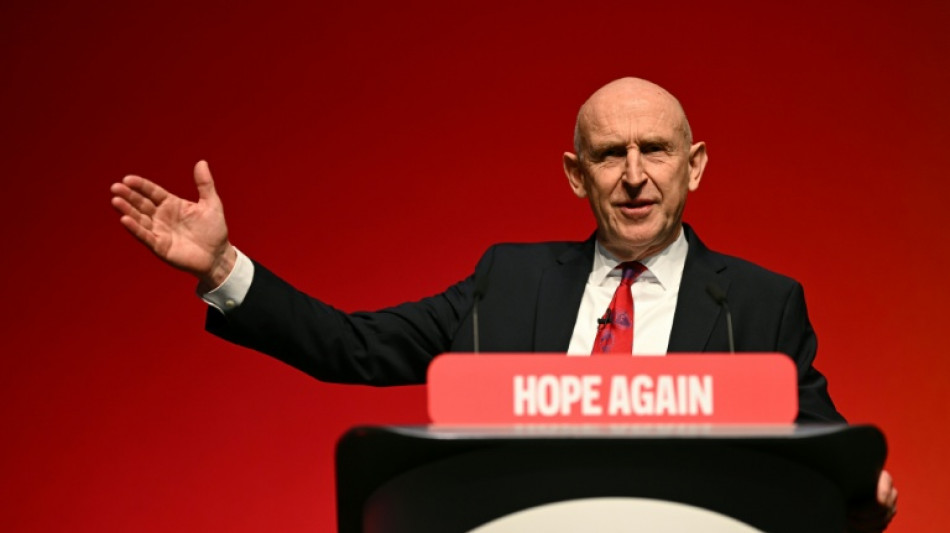
UK set for 'limited' budget giveaways as borrowing costs surge / Photo: Oli SCARFF - AFP

British Prime Minister Andy Burnham's new government unveils its first budget Wednesday, testing a commitment to ease the cost of living and ramp up defence spending with little financial room for manoeuvre.
It could prove to be a tall order for finance minister John Healey as rising inflation and borrowing costs -- largely a consequence of the US-Iran war -- increase the government's debt pile and heap pressure on businesses and individuals.
"This is a budget that is about breathing space for people, for businesses too, and that helps bring a bit of hope," Burnham, who replaced Keir Starmer as PM in July with their Labour party down in the polls, said Monday.
Speaking to the Good Morning Britain television programme, he added that the latest annual tax and spending plans will set out "the path to meet our NATO commitments" under a "funded" defence plan.
Labour had ruled out rises to income and capital gains tax, raising the prospect of spending cuts to balance the books, according to analysts.
The budget is expected to focus on smaller, more immediate measures to help ease pressure on household bills, they added.
"Priority has to be credibility first, which means a budget that clearly meets the fiscal rules, is fully costed and avoids large unfunded giveaways," James Wood, professor of political economy at the University of Cambridge, told AFP.
"With government debt at around 94 percent of GDP, the room to manoeuvre is limited," he added.
Healey, whose official title is chancellor of the exchequer, has pledged to abide by the rules laid out by his predecessor Rachel Reeves, which state that day-to-day spending must balance with government tax receipts.
The International Monetary Fund recently forecast that Britain's economy would grow faster than expected this year, before slowing slightly in 2027.
- Banks to be hit? -
The chancellor is expected to use a windfall tax on banks to fund a package of spending measures to help households manage rising energy bills.
Oil and gas companies operating in the UK already face a windfall tax on their bumper profits.
Burnham, who will on Tuesday have served 100 days as PM, has already offered the British public some relatively low-cost relief such as a tax cut on electricity bills.
Further measures could entail an extension to a freeze on fuel duty and more targeted help for the poorest households, according to reports.
Surging diesel costs at the pump helped push Britain's annual inflation rate to 3.5 percent in September, the highest rate for nearly a year. Average UK diesel prices went on to hit record highs earlier this month.
The government last week approved drilling in a North Sea gas field, claiming the move was aimed at boosting energy security rather than cutting bills.
The budget will also include measures to reduce "pointless paperwork" to lower costs for businesses, according to Healey.
A package of investment in artificial intelligence safety was announced by the Treasury over the weekend, amid growing global concerns over the cyber risks posed by AI.
"The short-run focus is likely to be on reassuring markets and supporting businesses... with more generous measures held back," said Wood.
- Surging borrowing costs -
The government's fiscal headroom of £23.6 billion ($31.5 billion) is expected to be slashed in an update given alongside the budget, as higher borrowing costs hike the state's debt repayments.
The Office for Budget Responsibility, an independent financial watchdog, will on Wednesday also publish its latest UK growth and inflation forecasts.
Government bond yields around the world have struck multi-decade highs in recent weeks as wider inflation climbs largely because of energy prices soaring on wars in the Middle East and Ukraine.
Rising inflation has cemented expectations that the Bank of England will hike its benchmark interest rate next month, further pressuring Britons holding loans, including mortgages.
H.Qureshi--al-Hayat