Pakistan's last antique restorers give old treasures new life / Photo: Farooq NAEEM - AFP

Sitting outside his small shop in a warren of alleyways in the ancient Pakistani city of Rawalpindi, Ahsan Shakeel buffed an antique brass pot to a high shine, pressing it against a mechanised wheel.
"We've removed all the dents, but it still needs polishing," the 72-year-old restorer, among the last still practising his craft, told AFP as the spinning buffer sent fine metal dust into the air.
Quitting a job as a hotel cook, Shakeel followed in his father's footsteps to become an antiques restorer, opening his workshop in the Bhabra Bazaar market in densely populated Rawalpindi in 1980.
Today, he is one of the last master restorers preserving antique metalware in Pakistan.
Rawalpindi's roots stretch back to prehistoric human settlements and over centuries the garrison city evolved into a major commercial hub where metalcraft from the Mughal and British colonial periods converged.
Moving inside his shop, Shakeel navigated wall-to-wall shelves stacked with centuries-old ewer jugs, samovars for boiling, dishes, jars and teapots, most of which were made of copper or brass.
He took down various items and enthusiastically explained to AFP their materials and origins.
The vintage items are now increasingly rare in the modern era in which they have been replaced by stainless steel and plastic kitchenware.
"I used to travel everywhere, Lahore, Gujranwala, Karachi, back and forth (to purchase antiques)," he said
- 'Life back into the dead' -
Shakeel procures the items he restores mostly from scrap yards, ports, or household clearances.
"Often, the condition of the items is so bad that no one would buy them," he said.
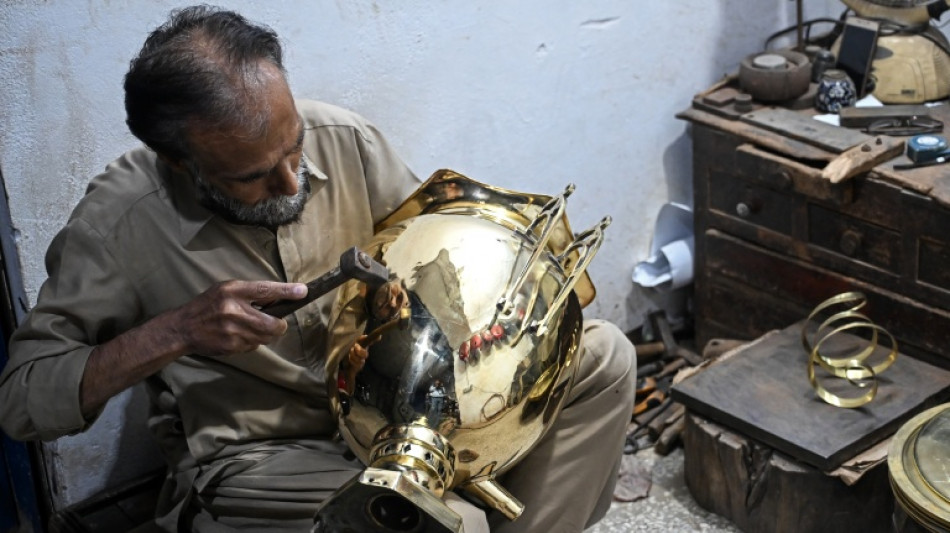
The shop owner and his colleague Shakeel Ahmed restore the battered items by hammering out dents, re-tinning the interiors over coal fires, and polishing the metal. A badly damaged item could take a few days to fix.
After restoration, a piece can sell between $100 and $1,000. Shakeel's customers are mostly collectors or antique enthusiasts, including foreigners.
Today, he mostly relies on online platforms and messaging applications to buy and sell antiques.
"I don't have the same health anymore, so I travel less," he said.
Prices for antiques are on the increase but the number of customers has fallen over time, Shakeel said.
"The money doesn't turn over quickly in this business. It's a very slow trade," he said.
"Customers who still exist, they are not many. They collect these things because they understand these items. Those who don't understand them would think it's all useless," Shakeel added.
Ahmed said he enjoyed restoring worn and damaged objects because they carry stories within them from different communities in the past or historical periods.
"This is a very old thing," the 56-year-old man said at his own dimly lit workshop, as he gently used a small hammer to smooth out little dents on a large brass hookah pipe for smoking tobacco.
"What we do is like putting life back into the dead," Ahmed said.
D.Zahrani--al-Hayat