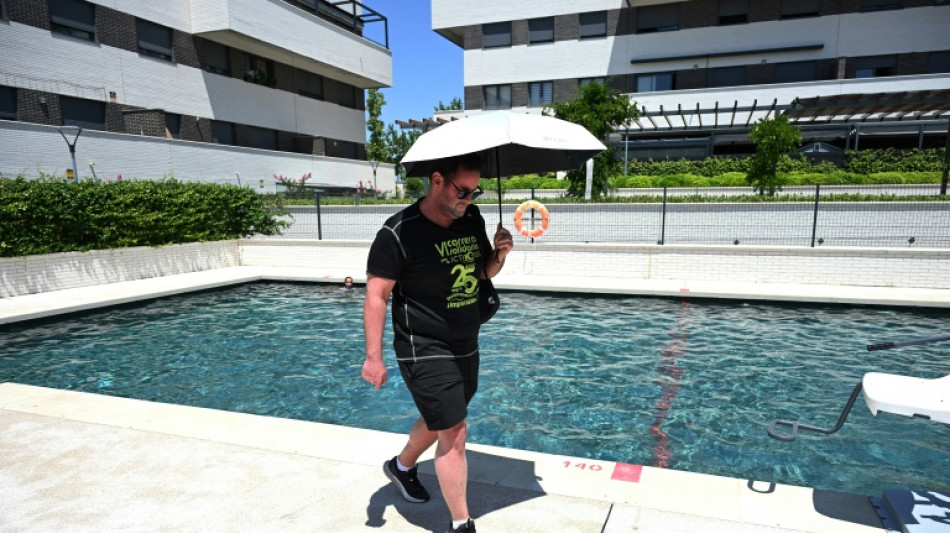
Spaniard's rare skin disorder ups danger of summer heat / Photo: Javier Soriano - AFP

Every summer, Alberto Gomez lives with a fear most people never consider.
The 36-year-old Spanish physics and chemistry teacher has a rare genetic skin disorder that leaves him unable to sweat properly -- and therefore unable to cool himself naturally during extreme heat.
"If you're having a hard time, imagine what it means for me. My fear is suffering a heatstroke and not being able to recover from it," he told AFP at a gym near his home in Arroyomolinos near Madrid.
As Spain's increasingly intense summers bring more frequent and prolonged periods of extreme heat, Gomez is among a small number of people living with the condition.
For them, a day that is merely uncomfortable for most people can quickly become life-threatening, forcing them to constantly monitor their bodies and avoid situations that could trigger dangerous overheating.
"When summer comes, we have a series of warning signs telling us something could happen if we don't start regulating our temperature," Gomez said.
Ichthyosis is a rare inherited disorder that leaves the skin excessively dry, rough and red.
Gomez's skin peels from head to toe, while other patients develop sores or blisters. One of the condition's most dangerous consequences is that many patients sweat little or not at all.
- Lasts for life -
"Sweat protects us when it's very hot because through perspiration, we release heat," said dermatologist Angela Hernandez, an ichthyosis specialist in Spain who estimates around 300 people in the country have the disorder.
"If we cannot release that heat, the body overheats to such an extent that it literally collapses. All the cells are destroyed," she said, describing the risk as potentially fatal.
Usually diagnosed at birth, the genetic disorder lasts for life, although its severity varies widely. There is no cure.
It affects the skin's ability to shed normally, causing thick, dry scales to build up and making patients more prone to dehydration, infections and painful cracking.
Beyond the immediate threat posed by extreme heat, the condition requires constant care.
Many patients spend hours each day applying moisturising creams to relieve cracked skin, while its visible symptoms can also expose them to unwanted attention and stigma.
Patients must also avoid overheating and prolonged exposure to the sun.
To cope with Spain's increasingly hot summers, Gomez rarely goes outside without a UV-blocking umbrella.
"Caps are useless for me because they trap heat around my head instead of letting it escape," he said.
- 'Needed to sweat' -
Gomez has not given up exercising, but only works out in an air-conditioned gym.
After just a few minutes of activity, small water-filled bumps appear on parts of his skin.
Jaime Garcia, whose 17-year-old son Alvaro also has ichthyosis, remembers realising the impact of the condition during his son's first summer.
Alvaro's face was very red and when he cried "it was as if the sweat was coming out through his tears, as though he needed to sweat," said Garcia, who heads the Spanish Ichthyosis Association.
When Alvaro started school, he was seated near a fan from April onwards to help keep him cool. By June, the afternoon heat became too much and he stopped attending classes in the afternoons.
Even a trip to the swimming pool requires careful planning.
Although swimming is not prohibited, Alvaro can spend only a few minutes in the water before showering, rubbing down his skin and discreetly applying moisturising cream.
Now a teenager, he never leaves home without a tube of moisturising cream -- a small but constant reminder that for people with ichthyosis, surviving summer requires vigilance every day.
D.Shihri--al-Hayat