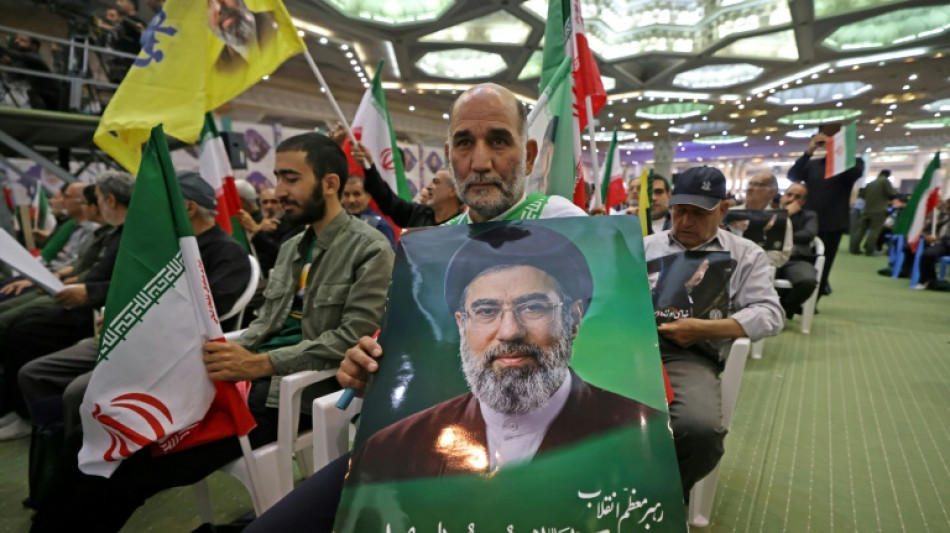
Is Iran's new supreme leader taking up the reins of power? / Photo: ATTA KENARE - AFP
Iran's new supreme leader Mojtaba Khamenei has not been seen in public since being appointed, his health condition is a mystery, and it's unclear how much power he wields.
But over three months after his father and predecessor Ali Khamenei was killed in an air strike at the start of the US-Israeli war against Iran, there are signs he is alive and involved in government affairs.
US President Donald Trump said Wednesday that Khamenei was "involved, absolutely", while Secretary of State Marco Rubio said on Tuesday "there are indications out there that he is increasingly engaging at some level".
Inside Iran, President Masoud Pezeshkian and armed forces joint operational command chief General Ali Abdollah have reported meeting Mojtaba Khamenei, even if no images ever filtered out.
He has communicated through around a dozen written statements in his name, the latest of which -- a diatribe against the "malicious enemy" -- was read out on Thursday at a ceremony commemorating the 37th anniversary of the death of revolutionary founder Ayatollah Ruhollah Khomeini.
"Mojtaba, likely with the assistance of his office, probably plays a role overseeing the general direction of policy, including topline positions for negotiations with the US," said Farzan Sabet, an Iran expert at the Geneva Graduate Institute.
"But his level of personal engagement with policy is probably far below that of his father" due to the security situation and his health.
Multiple Iranian officials have confirmed Mojtaba Khamenei was wounded in a US-Israeli strike, although there have been contradictory accounts over the extent of his wounds and if they were sustained in the very same strike that killed his father.
"As the security condition normalises, and his health improves, I would expect him to play a bigger role," Sabet added.
- 'Close to dominant players' -
"The role of Mojtaba Khamenei is unclear. It is very unlikely at this point that he has the degree of influence that his father used to have," Thomas Juneau, professor at the University of Ottawa told AFP.
But he added it "is also known that he is close to many of the dominant players today", including key figures in the Revolutionary Guards (IRGC) ideological army.
Juneau said that power appeared to be in the hands of an "informal committee" of IRGC commanders and a handful of senior politicians including parliament speaker Mohammed Bagher Ghalibaf, himself a former IRGC commander.
The latest of Khamenei's statements was read out on Thursday at the ceremony commemorating the death of Khomeini.
Like previous messages, it echoed the vociferously anti-American and anti-Israel rhetoric of his father, accusing the United States and Israel of trying to sow "division" among Iranians after suffering a "decisive blow" during the war.
But there was no surprise appearance by Mojtaba at the commemoration, an event his father had attended every year since Khomeini's death in 1989.
This year, an empty chair bearing Ali Khamenei's portrait stood at the mausoleum.
Mojtaba Khamenei's message was read out by Tehran's Friday prayer leader Mohammad Javad Haj Ali Akbari, while his previous statements have been relayed by state television.
Despite his absence from public view, authorities have made sure that Mojtaba Khamenei is present in the minds of Iranians.
Giant billboards around Tehran showing a triple image of Khomeini, Ali Khamenei and the Islamic republic's third supreme leader have stared down at residents since March, in a clear bid to show continuity of leadership.
- 'Change and continuity' -
It remains to be seen whether Mojtaba Khamenei will replicate the rule of his father, who was all powerful during his more than three-and-a-half decades in power.
In contrast to the vertical power structure under his father, the leadership is set to be more fuzzy with Mojtaba potentially set to be just one player in a set-up where the IRGC will play a more dominant role.
"A formal hierarchy still remains in Tehran, but in practice, power and authority are likely exercised in a more fragmented and diffuse manner," said Sabet.
Juneau said he expected "change and continuity" in Iran's system, with its "core identity" unchanged but a shift in how power is wielded after the death of Ali Khamenei, who was known for managing competing power centres.
"Mojtaba does not have his father's authority," he said.
"He does not appear to have the ability to play the role of balancer-in-chief and final arbiter of the system to the extent that his father did."
S.Harithi--al-Hayat