Stocks mostly higher, yen stays near 40-year low against dollar / Photo: Richard A. Brooks - AFP

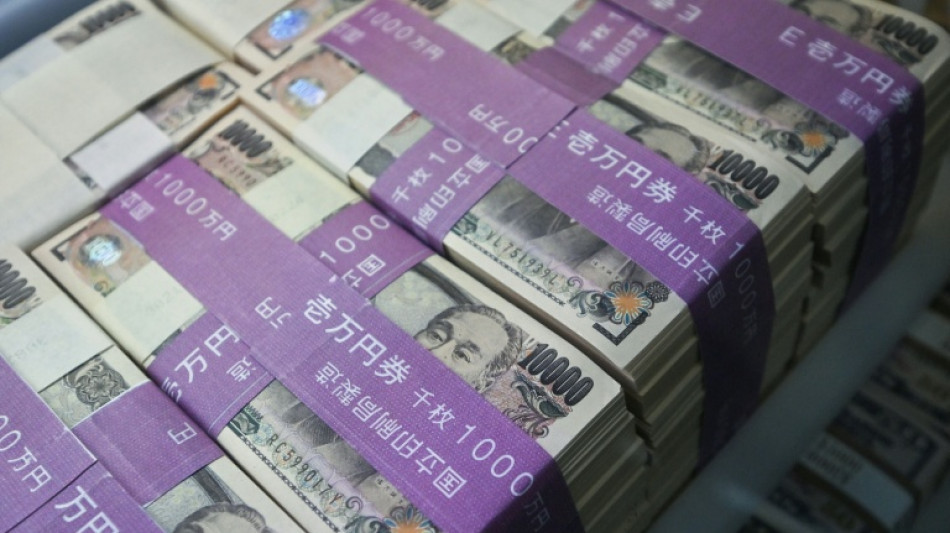
Renewed buying of technology stocks helped drive equity markets higher Tuesday while the yen held around a four-decade low against the dollar, reflecting Japan's low interest rates as US rates trend higher.
With investors more optimistic about an eventual end to the US-Iran war, the focus has returned to monetary policy and the surge in artificial intelligence investment.
"The second quarter, which ends today, was a BIG quarter thanks to the run by the mega-cap stocks and semiconductor stocks and the ceasefire agreement between the US and Iran," said Briefing.com analyst Patrick O'Hare.
Kathleen Brooks, research director at XTB trading group, said the last three months have "been dominated by stunning gains for chip stocks and tech-heavy indices, a strengthening dollar that has sent the yen down to a 40-year low and shifting geopolitical risks that are playing out in commodity markets."
Seoul's KOPSI index -- which includes chipmakers SK hynix as well as Samsung -- soared almost 68 percent during the quarter. The tech-heavy Nasdaq in New York was up over 19 percent going into the final day of second quarter trading.
Wall Street opened flat on the last trading day of the quarter.
Europe's main markets were higher in afternoon trading.
After a shaky start, Asian investors pushed tech companies higher Tuesday.
Seoul's Kospi index rose one percent but was still well down from its recent record high touched before last week's rout.
In Tokyo, the focus was also on the yen amid speculation that Japan's government could intervene in currency markets to push it higher against the dollar.
The yen fell as low as 162.52 per dollar amid expectations the US Federal Reserve would lift interest rates this year.
The yen's moves came ahead of US jobs data Thursday, with analysts warning that a stronger-than-expected reading could fan bets on a Fed rate hike sooner rather than later.
An increase in borrowing costs to a 31-year high by the Bank of Japan this month did little to support the yen, with government officials' warnings of an intervention also falling short.
Finance Minister Satsuki Katayama was reported by local media as saying Tuesday that Tokyo "will take appropriate action at any time as necessary".
"A major catalyst behind the dollar's move has been the arrival of new Federal Reserve chair Kevin Warsh, whose public comments have been interpreted as notably more hawkish" than US President Donald Trump might have wished, said Axel Rudolph, an analyst at IG.
"Warsh has repeatedly stressed the importance of maintaining the Fed's inflation-fighting credibility and has signalled a willingness to keep policy restrictive if price pressures prove persistent," he said.
Rudolph added that "the prospect of higher US interest rates has widened the expected policy gap between the United States and many of its major trading partners, increasing demand for dollar-denominated assets".
Oil prices drifted higher Tuesday, having returned last week to the levels seen before the US and Israeli strikes on Iran sparked a Mideast war and shut down traffic in the Gulf.
- Key figures around 1330 GMT -
New York - Dow: UP less than 0.1 percent at 52,214.59 points
New York - S&P 500: FLAT at 7,441.50
New York - Nasdaq Composite: FLAT at 25,824.53
London - FTSE 100: UP 0.7 percent at 10,559.64
Paris - CAC 40: UP less than 0.1 percent at 8,375.13
Frankfurt - DAX: UP 1.1 percent at 24,904.46
Tokyo - Nikkei 225: UP 0.9 percent at 70,062.32 (close)
Hong Kong - Hang Seng Index: DOWN 0.6 percent at 22,881.02 (close)
Shanghai - Composite: UP 0.5 percent at 4,094.40 (close)
Dollar/yen: UP at 162.34 yen from 161.92 yen on Monday
Euro/dollar: DOWN at $1.1403 from $1.1430
Pound/dollar: DOWN at $1.3229 from $1.3261
Euro/pound: UP at 86.18 pence from 86.17 pence
Brent North Sea Crude: UP 0.7 percent at $74.44 a barrel
West Texas Intermediate: UP 0.5 percent at $71.11 a barrel
burs-bcp-rl/gv
S.al-Qahtani--al-Hayat