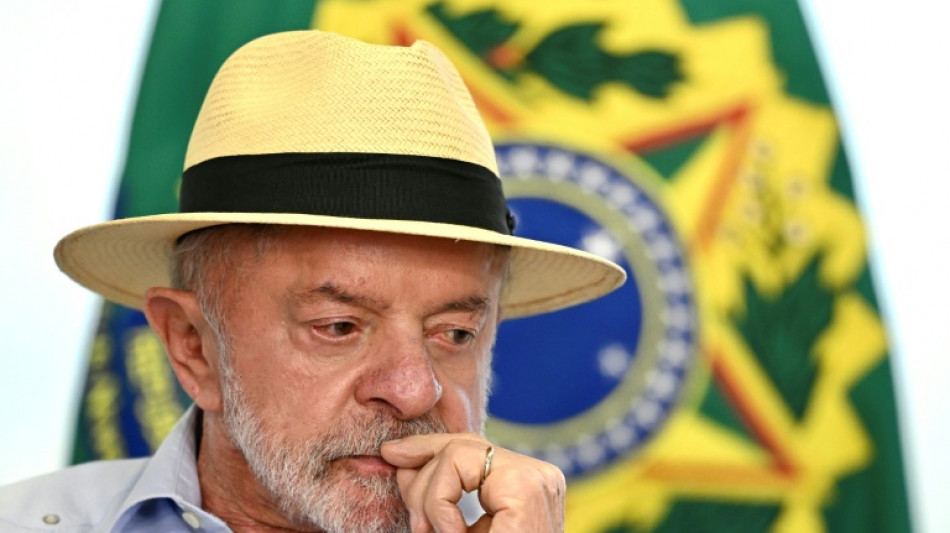
Jaded voters, same old choices: Brazil kicks off election campaign / Photo: Evaristo Sa - AFP
Brazil's leftist president Luiz Inacio Lula da Silva and his right-wing rival Flavio Bolsonaro kick off their election campaigns on Sunday in a race that has many voters feeling a weary sense of deja vu.
Voters head to the polls on October 4 deeply polarized and under the shadow of US President Donald Trump, who has openly backed conservative candidates in recent Latin American elections.
The race offers a familiar political script with minor cast changes.
Lula, 80, who is seeking a fourth and final term, is up against the son of former far-right president Jair Bolsonaro.
"The campaign is really weak. The presidential candidates, they're all bad. I won't vote for (Lula), I won't vote for Bolsonaro. I don't even know what I am going to do!" market vendor Rosalie Lourecal, 53, told AFP.
There are around a dozen candidates, with those trailing Lula and Bolsonaro polling in the single digits.
A survey by the Quaest pollster released Friday showed that in an expected runoff election, Lula would get 43 percent of votes to Bolsonaro's 40 percent.
With both frontrunners facing rejection rates of over 50 percent, the election will be a battle for a narrow pool of independent voters -- a sector where Bolsonaro has gained ground.
- Lula vs Trump -
Lula will launch his campaign with a rally in Sao Bernardo do Campo in the state of Sao Paulo, the birthplace of his political career, where he addressed massive crowds as a metalworker and unionist in the 1970s.
The veteran leftist made a dramatic comeback when he returned to office in 2023 after he was jailed on corruption convictions that were later annulled.
In his third term, Lula has been credited with expanding social programs, a major overhaul of the tax system, and reducing deforestation in the Amazon.
A key campaign focus in his campaign is Brazilian sovereignty faced with US tariffs and pressure from Trump, a Bolsonaro ally.
Lula said Friday he wanted to tell Trump: "Don't meddle in Brazil's affairs, especially regarding the election. If you do meddle, you'll lose."
Lula has vowed to increase defense spending, and to prioritize the fight against organized crime. Security is a major voter concern in the election.
- Bolsonaro 2.0 -
The 45-year-old senator Bolsonaro was thrust into the electoral race after his father was jailed for attempting a coup against Lula when he lost a 2022 election bid.
He has styled himself as a "more moderate" version of his firebrand father, while relying heavily on his enduring political appeal.
Bolsonaro has urged supporters to wear a t-shirt bearing his father's image at his rally Sunday on Rio de Janeiro's Copacabana beach -- where Jair Bolsonaro often drew massive crowds.
He says he wants to "rescue" Brazil, promising to be tough on crime and prioritize fiscal responsibility.
"I'm going to vote for Bolsonaro's son," said William Ramos, 40, owner of a school transport company who said he works seven days a week, 12 hours a day, for "a better life."
He mocked Lula's 2022 campaign promise that Brazilians would get back to eating picanha, a popular cut of beef with a price tag that has remained out of reach for many.
Brazil's statistics agency IBGE reports that poverty rates are the lowest since comparable records began in 2012.
The economy is growing solidly, unemployment rates are at record lows, and inflation has come down.
But, many Brazilians don't feel an improvement.
"A person earning minimum wage doesn't have the means to eat well or have a decent quality of life," said Ramos.
Mayra Goulart, political science professor at the Federal University of Rio de Janeiro, told AFP the main challenge for Lula and Flavio will be to reach "disengaged voters" who are highly likely to abstain.
Jairo Nicolau, a professor at the Getulio Vargas Foundation, told AFP women are a key demographic to win over.
They make up 53 percent of Brazil's 158 million registered voters, are more likely to vote, and helped Lula to his narrow victory in 2022.
M.Ajlan--al-Hayat