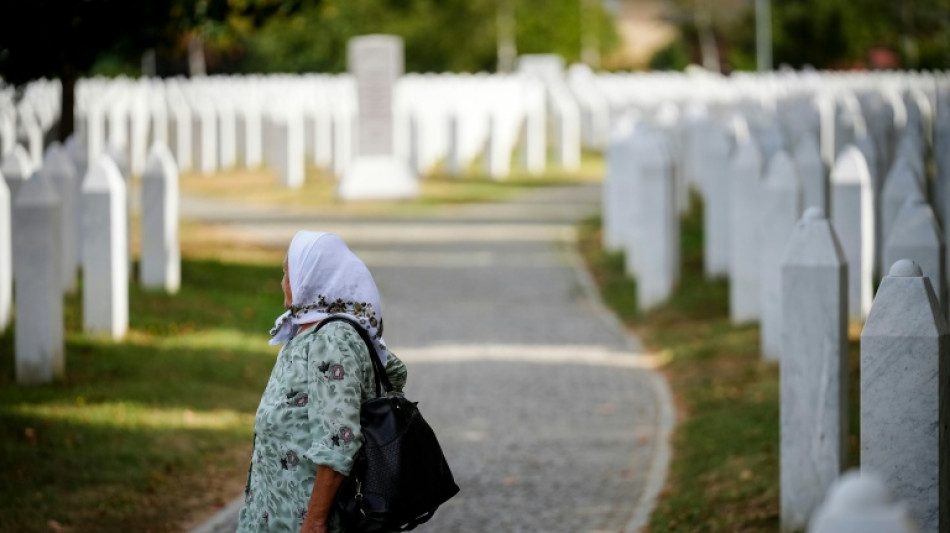
War criminal Ratko Mladic's death lays bare Bosnia's wounds / Photo: Nidal Saljic - AFP
To survivors of the Srebrenica massacre, the death of former Bosnian Serb military leader and war criminal Ratko Mladic changes little about his legacy.
Mejra Djogaz, whose three sons, husband and grandson were killed by forces led by Mladic, lives at the edge of the memorial centre in Potocari, where thousands of marble gravestones mark the victims of the 1995 massacre.
"It's because of him that I was left alone. And I'm not the only one who was left alone: all the mothers in Srebrenica, and many others across Bosnia and Herzegovina, suffered the same fate," the 77-year-old told AFP.
Mladic died on Thursday while serving a life sentence in The Hague for war crimes committed during the 1990s Bosnian war; his conviction led international media to dub him the "Butcher of Bosnia".
Decades on from the conflict, Djogaz said she remains too afraid to return home to her village on the outskirts of the town, which has been left almost emptied by the wartime killings.
Instead, she stays with friends within walking distance of the memorial site, where she can visit the graves of her family.
"I would have liked him to live even longer, so that he could suffer more, as we mothers suffer," she said of Mladic.
- 'His ideas are not dead' -
Mladic experienced several strokes in recent months before his death in hospital, as he served a life sentence for genocide, war crimes, and crimes against humanity during the Bosnian War.
He became infamous for his role in the Srebrenica massacre, where more than 8,000 Muslim men and boys were killed and their bodies dumped in mass graves, Europe's worst act of bloodshed since World War II.
Sehida Abdurahmanovic, a member of the main association of mothers in Srebrenica, said knowing he died suffering was some solace to victims' families, but his conviction was more enduring.
"For us, the main thing is that he was convicted and that he was serving his sentence," said Abdurahmanovic, whose brother went missing during the massacre and has never been found.
"With this sentence, his life was already over."
Fadila Efendic, whose son and her husband were killed in July 1995, said Mladic's death brought "neither a joy nor a particular sadness".
"What is particularly difficult for me to accept is that his ideas are not dead," the 74-year-old said.
"If they had disappeared, then I could be happy about it. Unfortunately, they continue to exist. This ideology is not dead."
- 'State honours' -
In parts of Serbia and Bosnia's Serb statelet, Republika Srpska, Mladic is still lauded as a hero, and his death was greeted with vigils and memorials overnight.
In Zvornik, on the border with Serbia, hundreds marched through the streets chanting his name, waving Serbian and Republika Srpska army flags and carrying banners bearing his portrait.
In Visegrad, where thousands of Bosnian Muslims, or Bosniaks, were brutally killed in 1992, a group of young people unfurled a banner honouring Mladic from a bridge and lit flares.
In Serbia's capital of Belgrade, footage aired by a pro-government private television channel, Informer, which had rolling coverage in tribute to Mladic, showed dozens of men holding flares on the city's main bridge.
Serbian officials have remained largely restrained in their reactions, with President Aleksandar Vucic telling media on Friday that it was "not the day for song or for a celebration" after supporters greeted him with chants at an unrelated event in a western Serbian town.
"We tried and did everything we could to ensure that General Mladic would spend the end of his life in Serbia," Vucic said.
The court rejected requests for Mladic's release on health grounds, a move the populist leader labelled "unprecedented and unjustifiable behaviour".
Serbia's justice minister Nenad Vujic said Mladic "will receive all the military and state honours to which he is entitled", but Vucic did not confirm whether plans were underway for a state funeral.
"Should the family wish for him to be buried on the territory of Serbia, we will help ensure that this is done in a dignified and proper manner," he said.
Serbian officials were awaiting details on when authorities in The Hague would release the body, he added.
Regardless of reactions from his supporters, Abdurahmanovic said attempts to revise his legacy were in vain.
"History will undoubtedly remember him as one of its great negatives, a war criminal," she said.
Z.Johani--al-Hayat