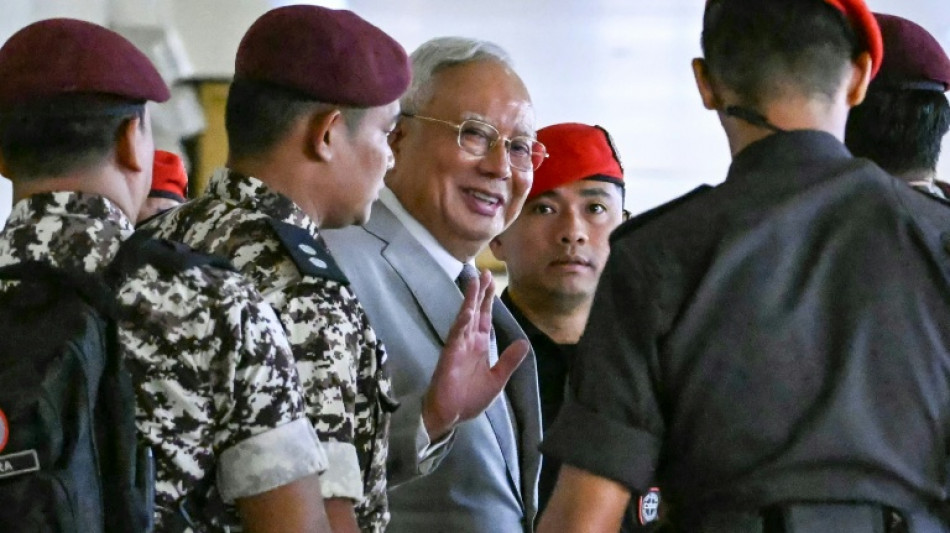
Malaysia furore after Najib wins conditional house arrest / Photo: MOHD RASFAN - AFP

A conditional royal pardon letting former prime minister Najib Razak serve the rest of his jail sentence under house arrest has ignited a new row surrounding the $4.5-billion 1MDB scandal.
Critics say Najib should remain behind bars, while supporters have rallied around the former leader and launched a campaign to help him pay a fine tied to his transfer to house arrest.
Najib, 73, was jailed in 2022 for his role in one of the largest-ever global plunders of a sovereign wealth fund, the now-defunct 1Malaysia Development Berhad (1MDB).
On Friday, King Sultan Ibrahim granted Najib's request to complete the remainder of his six-year sentence under house arrest -- provided he pays a 50-million-ringgit ($12 million) fine.
Najib is also appealing a separate 15-year prison term in another 1MDB-related case.
Prosecutors say about $4.5 billion was siphoned from the state fund in the 2010s, triggering investigations from Malaysia to the United States.
The scandal helped bring down the United Malays National Organisation (UMNO), ending the party's six-decade grip on power in 2018.
Yet Najib remains a popular figure among his base and UMNO's grassroots supporters.
- 'Mockery of the law' -
"How can a convicted felon with more cases awaiting trial be allowed house arrest?" said James Chow, a 49-year-old entrepreneur.
"It's a waste of time and money and a mockery of the law," he told AFP.
Shyam Priah, 52, chief executive of a non-profit organisation, said she respected the king's "constitutional prerogative to grant a pardon".
But she questioned efforts to raise money for Najib's fine.
"Seeing ordinary Malaysians being mobilised to contribute 10 ringgit towards a 50 million ringgit fine for a former prime minister raises a bigger question for me about our priorities as a society," she told AFP.
"Ten ringgit can mean a meal for someone who is struggling," she said.
But Najib's supporters welcomed the king's decision.
"The supporters who love Najib have been looking forward to the moment he would be granted house arrest," Radiaa Rashid, 68, told AFP.
"We miss Najib Razak. Even though he can't be released, at least he'll be at home with his family, with his grandchildren and children," said supporter Suzzalina Anura, 43.
Local media reported donations topped one million ringgit by Monday after the campaign was launched, although some critics responded by contributing as little as one sen (0.01 ringgit) in protest.
- 'Difficult position' -
The episode has also highlighted UMNO's ongoing struggle to balance loyalty to its former leader with efforts to move beyond the scandal before the next general elections due by February 2028.
Bridget Welsh, an expert on Malaysian politics at the University of Nottingham Malaysia says UMNO's fundraising initiative has put the party in a "difficult position".
On one hand, the party must show support for Najib and reassure traditional supporters. On the other, it must appeal to younger voters who tend to have a far harsher view of corruption.
"The house arrest serves to build party unity, but it comes at the cost of outreach for the party, as it speaks to the legacy baggage the party still carries," she told AFP.
She said fundraising "within some traditional supporters... is seen as important given that Najib's accounts are believed to be frozen".
Yet the campaign risked pushing away younger voters and those in the political centre.
"With younger voters and those in the middle ground, this is alienating, seen as a party not willing to admit mistakes," Welsh said.
B.Sumairi--al-Hayat