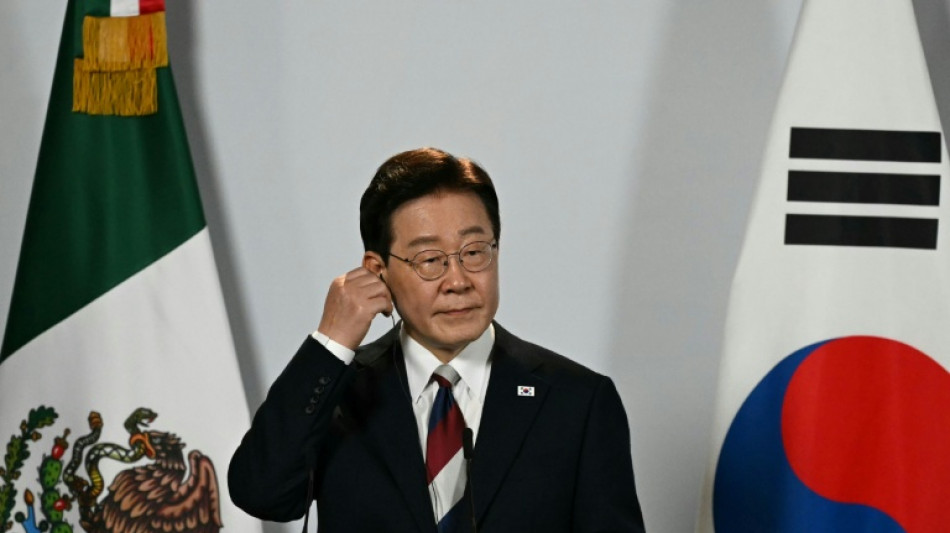
Seoul summons Ukraine envoy in row over North Korean POWs / Photo: Yuri CORTEZ - AFP
South Korea summoned Ukraine's envoy in Seoul on Monday to express "serious concerns" over Kyiv's disclosure that two North Korean prisoners of war had been transferred to the South, saying the operation should have been kept confidential.
The move followed Seoul's demand for an apology from Ukraine for denying an agreement to keep the transfer from the public.
The intensifying dispute risks complicating Kyiv's efforts to obtain weapons from allies including South Korea to fight off bombardments from Russia.
Ukrainian President Volodymyr Zelensky disclosed last week that his country had sent two North Korean soldiers to the South, saying they were "not easy to capture alive".
South Korea's foreign ministry said it had "summoned Andrii Vieshkin, charge d'affaires of the Ukrainian Embassy... and conveyed the government's serious concerns regarding the transfer of North Korean prisoners of war".
Expressing "strong regret", the ministry said Kyiv had "unilaterally revealed" the transfers without prior consultations or explanation.
Kyiv's actions "seriously undermine trust between the two governments and risk damaging friendly bilateral relations", it said.
Hours after Zelensky's remarks at the United Nations, South Korea's President Lee Jae Myung expressed his dismay.
"I do not know why the Ukrainian side broke the agreement and made the matter public, but it is very disappointing," he wrote on X.
Seoul said confidentiality was key to protecting the POWs' relatives from any repercussions in North Korea.
"The families left behind in the North could face severe punishment," Cho Seong-ryoul, a former policy adviser to the presidential national security office, told AFP.
In a statement to AFP on Monday, the foreign ministry said that "as the matter concerns the personal safety of the individuals involved and their families, the two sides had agreed to handle it confidentially".
Zelensky's aide Dmytro Lytvyn sought to play down the disclosure, saying that the president did not share any personal details.
Ukraine is an "open country" and it would be unusual to hand over the prisoners in secret, he added.
But Seoul condemned the decision, noting that Zelensky's press office had denied there was a confidentiality agreement.
The South Korean presidential office has demanded "an official explanation and apology", said Seong Ghi-hong, senior presidential secretary for public relations, in a statement late Sunday, adding that Seoul was "considering additional measures that may be necessary regarding this matter".
- 'Backlash' -
Ukraine captured the two North Korean soldiers early last year among Pyongyang's troops fighting for Moscow.
One of them told South Korean media he was conscripted aged 17 and had served in a reconnaissance unit.
A South Korean lawmaker had previously said the pair wanted to live a "normal life" in the South.
Park Won-gon, a professor at Ewha Womans University in Seoul, said Kyiv's disclosure may have sparked concern that it could feed into Pyongyang's antipathy towards South Korea.
Since taking power in June 2025, Lee has reversed the stance of his hawkish predecessor Yoon Suk Yeol, offering nuclear-armed Pyongyang talks without preconditions.
The South Korean president "appears to be taking a 'low-key' approach as he is mindful of a possible backlash from North Korea," said Park.
"North Korea has been using the deployed soldiers to create a heroic narrative for regime propaganda, and the South Korean government appears concerned that confirming the prisoners' return to the South and publicising it could further fuel hostility towards Seoul," he said.
The row also risks complicating Kyiv's requests to Seoul for armaments supplies.
South Korea has so far not provided lethal weapons to Ukraine, citing a domestic ban on militarily aiding countries at war.
Nevertheless, it has been considering requests for defensive weapons, especially since North Korea deployed troops to support Russia.
The incident "has dealt a significant blow to the relationship of trust between South Korea and Ukraine", Lim Eul-chul, a professor at Kyungnam University, told AFP.
N.Dossary--al-Hayat