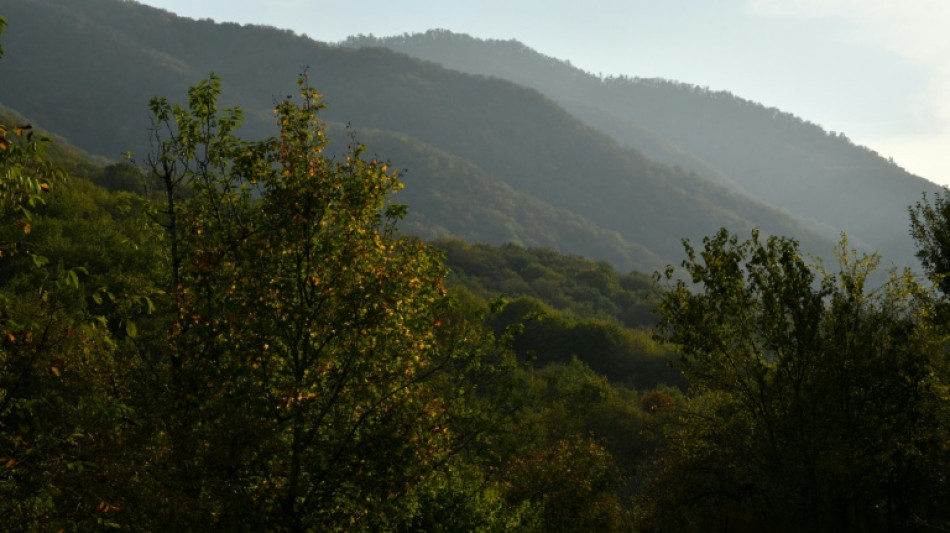
Forest destruction tests Armenia-Azerbaijan peace push / Photo: STRINGER - AFP

From a hillside above Armenia's Shikahogh nature reserve, local official Marat Harutyunyan pointed to forests cleared for Azerbaijan's military, construction Yerevan says threatens rare wildlife and the livelihoods of local villagers.
The battle over the fate of the forest exposes the deep, lingering tensions between the two countries as they seek to broker a lasting peace after three decades of hostility and multiple wars.
In advances in 2021-2022, Azerbaijan captured parts of the reserve that lies along the countries' shared border.
The conflict culminated in 2023 when it retook Karabakh from Armenian separatists, prompting the entire Armenian population -- some 100,000 people -- to flee.
The two countries have since tried to broker a permanent peace deal and last year initialled an agreement in Washington, seen as a major step towards ratification.
But while the capitals talk of detente, in the rural southern Armenian region of Syunik, residents are still on edge.
Nearby Azerbaijani military positions and landmines cause them to fear for their safety.
"All the land is directly in the enemy's sights," said Harut Aghatelyan, a 35-year-old biologist who has worked at the reserve for the past 15 years.
He has repeatedly found dead animals with missing legs -- blown up in landmine blasts that echo through the woods.
- 'Cut down everything' -
After seizing part of the area, Azerbaijan's military is now building wide forest paths to improve access and supply lines.
Above Srashen village, pale roads snake through the autumn woodland, and a police checkpoint blocks the old route towards the reserve.
Hilltop Armenian and Azerbaijani flags mark competing positions, sometimes only a few hundred metres apart.
Azerbaijan's advances have left a nearby village, Nerkin-Hand, surrounded on three sides, as its troops "occupy more than 2,700 hectares of the reserve and several hundred hectares of agricultural land", Harutyunyan, the Armenia official, said.
"They cut down everything, without checking whether a species is in the Red Book or not," he added, referring to Armenia's register of endangered species.
Armenia has highlighted the issue as it hosts the UN's COP17 biodiversity summit in Yerevan, where states gather to review global efforts to protect species and their habitats.
- 'Large-scale ecocide' -
Azerbaijan has rejected accusations of occupying Armenian territory, saying that the border in the area has not been formally demarcated.
Established in 1958, Shikahogh covers roughly 12,400 hectares of oak and beech forests, plane tree groves and yew -- an endangered species.
It also shelters Caucasian leopards, brown bears and bezoar goats.
Harutyunyan fears tree felling and engineering work could trigger landslides, mudflows and rockfalls.
But the military presence and landmines have made assessing the consequences on the ground impossible, residents and specialists say.
"Nobody knows the true extent of the damage," said forest expert Ayser Ghazaryan.
His analysis of satellite images indicates earthworks across about 90 hectares, including some 60 hectares of forest, and the felling of an estimated 14,000 to 16,000 cubic metres of timber.
It is not clear whether a full recovery from what he called "large-scale ecocide" is even possible.
- 'No security' -
The loss of farmland and grazing is also threatening locals' livelihoods.
Muraz Arzumanyan, 26, is unemployed and lives with his parents. Trained as a metallurgist, he previously served as a soldier with the Armenian army.
"How can I start a family and have children when there is no security?" he said.
"I cannot imagine my child growing up here, going into the yard to play and run around, constantly in someone's sights."
The school in Shikahogh has just one pupil.
Elderly residents say they can no longer visit relatives' graves.
The municipality runs free buses and hopes those who left will one day return.
Aghatelyan, the biologist, meanwhile is determined to stay.
He raises rabbits and refuses to leave the village where his family has lived for generations.
"I was born and grew up surrounded by forests. I love these forests," he said.
"My child is 18 months old, and I want him to grow up here."
E.Hilali--al-Hayat