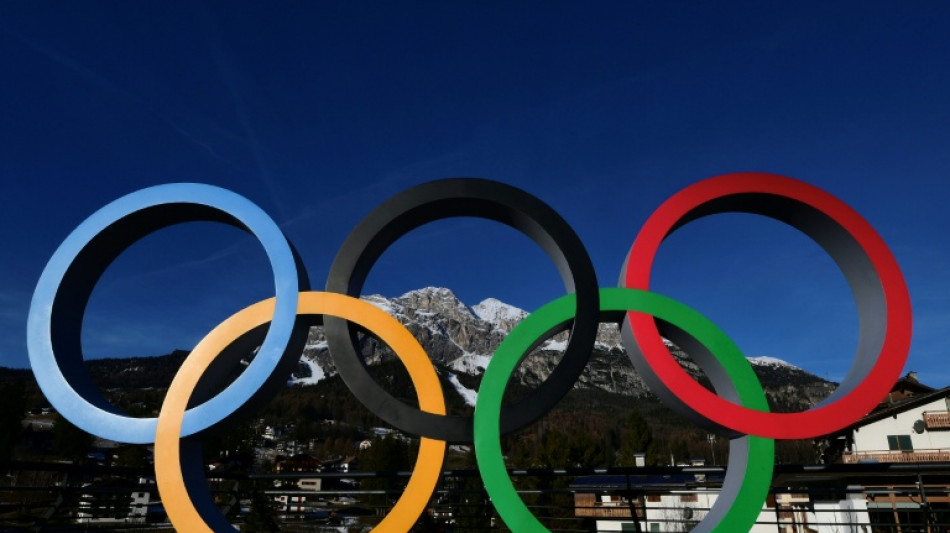
Winter Olympics to showcase Italian venues and global tensions / Photo: Stefano RELLANDINI - AFP

The 2026 Milan-Cortina Winter Olympics open on Friday as the Games return to their traditional heartland of the European Alps for the first time in 20 years, while organisers are praying skiing great Lindsey Vonn is fit to compete.
These Games will use a host of existing venues, meaning they will stretch for 350 kilometres (217 miles) across northern Italy from Cortina -- one of the world's iconic skiing locations -- to Milan, with other "clusters" spread through the Alps.
Organisers say that avoiding new construction meets the sustainable brief for an event often accused of creating white elephants, but they admit it has added complexity too.
The first Olympics since the re-election of US President Donald Trump are set to be buffeted by global turbulence.
Italy has maintained that it will retain control of all security operations after it emerged that a branch of the US Immigration and Customs Enforcement (ICE) will be sent to Italy in an "advisory" role, sparking anger in the host nation.
Olympic power Russia's team of just 13 must compete as neutrals, a sanction imposed by the International Olympic Committee after Moscow invaded Ukraine weeks after the last Winter Games in Beijing in 2022.
The sports programme begins on Wednesday, but the Games officially start two days later with a spectacular opening ceremony at the San Siro stadium in Milan featuring performances from US singer Mariah Carey and Italian opera star Andrea Bocelli.
US Vice President JD Vance and Secretary of State Marco Rubio are expected to attend.
When the full programme of sport gets under way, all eyes will be on Vonn, whose comeback at 41 could be the storyline of this Olympics, provided she can recover from the hard fall she suffered in a World Cup race in Crans-Montana, Switzerland, on Friday.
Following the crash, Vonn said she had injured her left knee, the joint that was fortified with titanium in surgery which allowed her to return to the circuit last year after retiring in 2019.
Vonn insisted "my Olympic dream is not over" and she is due to give an update on Tuesday.
Also eagerly awaited is the men's ice hockey competition, with stars from the National Hockey League (NHL) in the US and Canada -- the world's strongest -- taking part for the first time since 2014.
- 'Additional complexities' -
Kirsty Coventry, the new IOC president, is also under scrutiny as she oversees her first Games since her election as the movement's first woman leader in March.
Coventry admitted that the approach of using existing venues, which are often long distances apart, has complicated the task for organisers.
"I think initially we all thought, 'oh, well, we'll just have it be a little bit more dispersed because that's more sustainable'. Yes, that is very true, but it has added additional complexities in the delivery of the Games," the Zimbabwean said.
Two of the new venues, the sliding centre in Cortina for the bobsleigh, skeleton and luge events and the main ice hockey arena in Milan have caused the most headaches.
The location of the sliding centre became a political hot potato after the IOC initially said those events would have to be held at existing sites in Switzerland or Austria.
But the insistence in late 2023 of Italy's Deputy Prime Minister Matteo Salvini that the events be held in Italy led to a breakneck race to build a track in Cortina, where the 1956 Winter Olympics were held.
Construction didn't start until February 2024, sparking open opposition from the IOC, but it was completed just in time for pre-approval in March last year -- a win for Prime Minister Giorgia Meloni's hard-right government.
Meanwhile, repeated delays to the construction of the main ice hockey arena, located in the Santa Giulia district on the outskirts of Milan, led to uncertainty right up until last month over the participation of the NHL players.
Those doubts weren't removed until the successful hosting of a test event at the venue less than a month ago.
Organisers admitted on Sunday that some parts of the Santa Giulia venue are unfinished, but insisted all the scheduled games there would go ahead.
Milan-Cortina estimate the final bill for the Olympics will be 5.2 billion euros ($6 bn). Of that 3.5 bn euros is going on infrastructure and 1.7 bn euros on staging the Games.
V.Sahli--al-Hayat