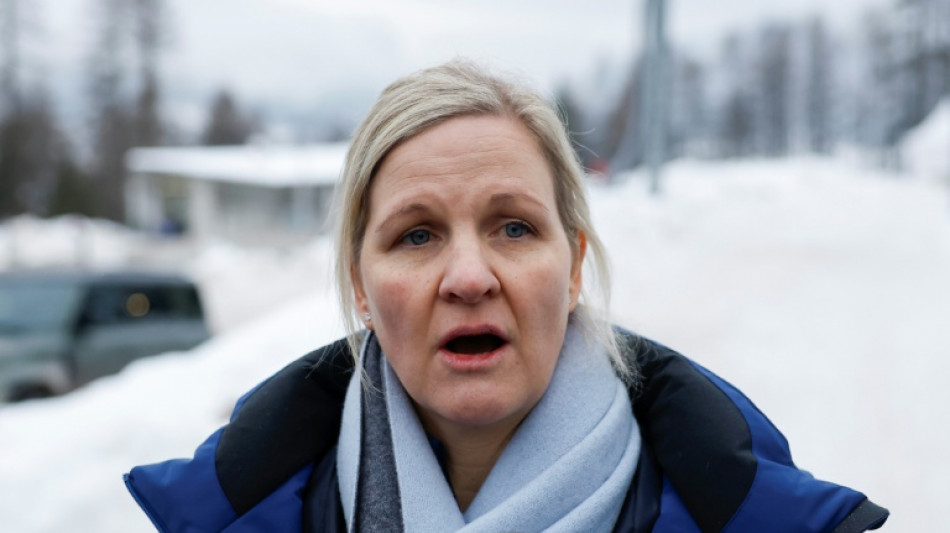
Ukrainian's disqualification from Winter Olympics gives Coventry first test / Photo: Odd ANDERSEN - AFP

Did International Olympic Committee president Kirsty Coventry really think she could keep politics out of sport?
The disqualification on Thursday of Ukrainian skeleton athlete Vladyslav Heraskevych from the Milan-Cortina Winter Olympics has given Coventry the first major test of her presidency as she oversees her maiden Games since her election last year.
Heraskevych was barred from the Milan-Cortina Games after refusing to back down from wearing a helmet adorned with pictures of Ukrainian sportsmen and women killed since Russian invaded in 2022.
Coventry had gone to Cortina d'Ampezzo where Heraskevych had been due to take part in the qualifying for the skeleton on Thursday to try to persuade him in person not to wear the helmet.
Heraskevych's helmet violates Rule 50 of the Olympic Charter, which prohibits any form of "political propaganda" at competition venues, in the Athletes' Village, or during medal ceremonies.
"I was not speaking to him in that room as a president. I'm speaking to him as an athlete. I really wanted to see him race today," said Coventry, tears in her eyes, after the Olympic gold medal-winning former swimmer failed to change the Ukrainian's mind.
In fact, the rule was reinforced in 2021 by a wide-ranging survey of athletes conducted by its Athletes' Commission, which Coventry then headed.
- Under strain -
Aware of the uproar a disqualification would provoke, the body made multiple attempts at compromise.
It first offered the athlete the option of wearing a plain black armband, and reiterated he could wear his helmet and retain full freedom of expression in the mixed zone -- where athletes talk to journalists after their events -- and press conferences.
"No one -- no one, especially me -- is disagreeing with the messaging. The messaging is a powerful message. It's a message of remembrance. It's a message of memory," Coventry said.
"In this case -- the field of play -- we have to be able to keep a safe environment for everyone. And sadly, that just means no messaging is allowed," she added.
Heraskevych refused to back down, saying after meeting Coventry: "I did not break any rule."
Ukrainian President Volodymyr Zelensky was quick to react, accusing the IOC of playing "into the hands of aggressors" -- Russia.
Sports Minister Matviy Bidnyi said Ukraine would go through legal channels to reverse the decision, but the Court of Arbitration for Sport said it had not yet received any request to appeal from Heraskevych.
Even before any potential legal debate over athletes' freedom of expression begins, Coventry is already seeing the course she outlined at the IOC Session just before the Milan-Cortina Games come under strain.
"We understand politics and we know we don't operate in a vacuum. But our game is sport," she said.
"That means keeping sport a neutral ground, a place where every athlete can compete without being held back by the politics or divisions of their governments."
Such a stance, while common among sports bodies seeking to protect their competitions from interference, appeared highly optimistic given the many challenges that the Russian-Ukrainian conflict posed to Coventry's predecessor, the German Thomas Bach.
The IOC first had to -- "with a heavy heart", as Bach said -- depart from its own rules by banning Russian athletes outright from all international competitions, in response to the hostility their presence provoked.
When the body began allowing Russia's partial reintegration to Olympic competition under a neutral banner in early 2023, Bach repeatedly took a hard line with the Ukrainian authorities when they objected to their own athletes having to face Russian competitors.
"We cannot have athletes having pressure put on them by their political masters," IOC spokesperson Mark Adams said on Thursday.
It now remains to be seen whether Coventry, who for now favours an "athlete-to-athlete" approach while avoiding the political sphere, will enter into direct dialogue with Kyiv.
Also coming into view for Coventry is the 2028 Los Angeles Olympics, and the prospect of dealing with US President Donald Trump.
Michael Payne, a former head of marketing for the IOC who is well-informed of its workings, said he felt the IOC and Coventry had been left between "a rock and a hard place".
"But no matter how much sympathy you had to the Ukrainian cause, the IOC had to defend the principle of a clean field of play," he told AFP.
"Anything else would have opened a pandora's box and set a precedent for LA 28. Imagine Palestine versus Israel or anti-Trump protests."
E.Hilali--al-Hayat