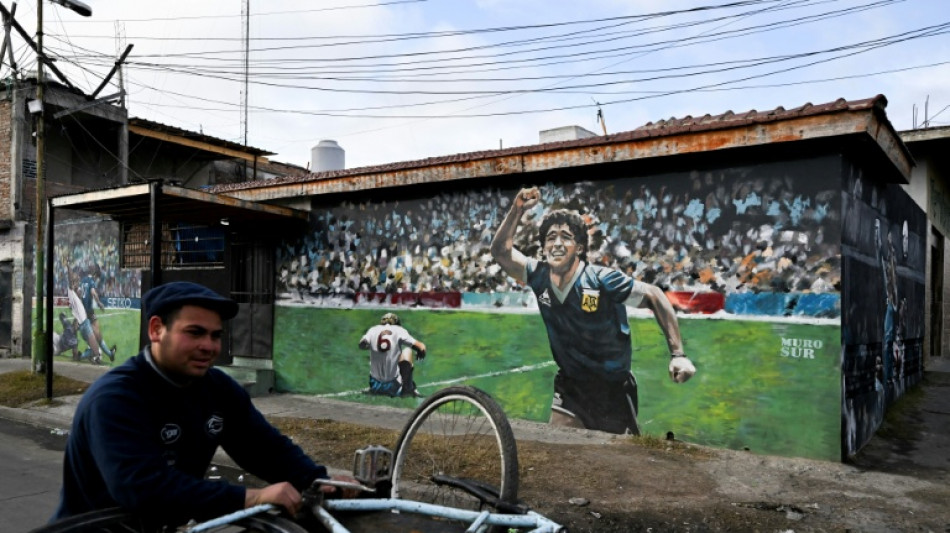
Argentina v England in the World Cup: much more than just a game / Photo: Luis ROBAYO - AFP

From the war they fought over the Falklands to Diego Maradona's infamous "Hand of God" goal, Wednesday's semi-final against old foe England has ramifications far beyond the pitch for many Argentines.
The 2026 anthem of the reigning champions, "La Cuarta Estrella" (The Fourth Star), referring to the fourth title Argentina is chasing, lists off the themes that loom large over the clash in Atlanta, Georgia.
Unsurprisingly, the Falkland Islands, a windswept archipelago in the South Atlantic that Britain occupied in the 19th century but which Argentina claims as part of its territory and over which the two fought a war in 1982, topped the list.
"For Malvinas, for Diego, for Leo's (Messi's) last, Argentina, I want to see you double (back-to-back) world champions," goes the song, using the Argentine name, Malvinas, for the Falklands.
"I'm going crazy, I haven't slept, I can't think of anything else," Ezequiel Murmis, a 33-year-old teacher, told AFP as he left a screening of "El Partido", a documentary about Argentina's historic World Cup quarter-final win against England in 1986.
The South Americans won 2-1 thanks to Maradona's self-described "Hand of God" goal -- in fact he punched the ball into the net.
Maradona, who died in 2020, followed that controversial goal with a superb individual effort, weaving through the mesmerized England players, that has been dubbed the Goal of the Century.
Ernesto Alonso, who fought in the Falklands War, which ended with 649 Argentines and 255 Britons dead and victory for Britain and then prime minister Margaret Thatcher, downplayed the importance of that conflict in Wednesday's game.
"In a way, Maradona already avenged us in 1986," he said. "Of course we're all excited and want to win but we cannot shift the responsibility for the Malvinas issue onto the national team."
- Falklands loom large -
The Falklands are a huge marker of Argentine identity, with the country's claim to the islands writ large in the constitution, school books, countless murals and tattoos and in neighborhoods and stadia named "Malvinas Argentinas."
In a highly divided society, where left and right view each other as mortal enemies, the Falklands and the national football team, people often muse, are about the only issues all Argentines can get behind.
But 2026 is not 1986, when the wounds of the war were still festering and the pressure on Maradona and Co. to restore the country's lost honor was paramount.
"That game was tainted," said Andres Burgo, the author of "El Partido," which was a book before being turned into a documentary.
This year's semi-final, he said, "has less symbolic importance and more sporting significance."
And yet, in a sign that the Falklands still rankle deeply, the documentary is playing to packed-out theatres.
Leaving the cinema in Buenos Aires, Tomas Barbeito, a 33-year-old insurance agent clad in an Argentina team top, said he was "very anxious" ahead of the game.
"It's like we want to avenge something we shouldn't have to avenge," he said.
- Similar football cultures -
As proof that taking on England still excites passions, Messi and team could be seen jumping up and down after their win over Switzerland to chants of: "El que no salta es un ingles!" (He who doesn't jump is English!).
The fervor of Argentine supporters, with their chants and taste for provoking and mocking their rivals, has perhaps no equal, apart from England itself.
In both countries, the passion for the game has also regularly spilled over into violence.
Burgo said that despite their rivalry, Argentines found an echo in English football culture.
"There are countries that don't have a passion for football, like the United States; countries that have passion but not a (football) culture. England has both, passion and culture, and I think Argentine fans recognize and respect that," he said.
Barbeito echoed that sentiment.
"It's kind of contradictory," he said. "But the truth is, I like the English and how they live and breathe football."
V.Sahli--al-Hayat