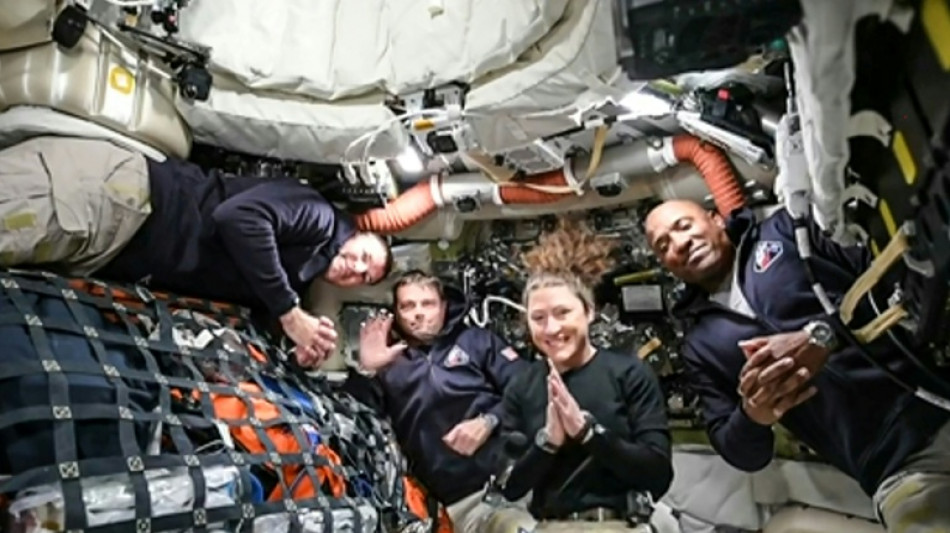
Giant step for humankind: Artemis crew to set space distance record / Photo: Handout - NASA TV/AFP

Four Artemis II astronauts are taking a giant step for humankind Monday when they shoot deeper into space than anyone before and glimpse parts of the Moon never seen by the naked eye.
The NASA mission swept earlier into the Moon's gravitational sphere of influence, meaning their spacecraft is now in the natural satellite's neighborhood, with lunar gravity outmuscling any pull from Earth.
The Orion capsule will whip around the Moon, setting the crew up to reach an estimated record 252,757 miles (406,772 kilometers) from Earth, before starting the journey home. This will surpass the 1972 distance record set on Apollo 13 by 4,102 miles.
Swooping around the far side of the Moon, the crew of four will witness previously hidden lunar territory -- the sphere looming large through their capsule windows.
The Moon will appear to the astronauts "about the size of a basketball held at arm's length," Noah Petro, head of the US space agency's planetary geology lab, told AFP.
Adding to the historic nature of the mission led by Reid Wiseman, the Artemis II crew includes several firsts.
Victor Glover will be the first person of color to fly around the Moon, Christina Koch will be the first woman, and Canadian Jeremy Hansen the first non-American.
- Human eye vs camera -
The astronauts have already started seeing features never previously glimpsed directly.
An image sent back by the crew showed the Moon's Orientale basin visible, a massive crater that before had only been viewed by orbiting, uncrewed cameras.
Speaking to Canadian children live from space, Koch said the crew was most excited to see the basin -- sometimes known as the Moon's "Grand Canyon."
"It's very distinctive and no human eyes previously had seen this crater until today, really, when we were privileged enough to see it," Koch said during a question-and-answer session hosted by the Canadian Space Agency.
Near the end of their flyby, the astronauts will witness a solar eclipse, when the Sun will be behind the Moon.
Despite the technological advancements since the Apollo missions, NASA still relies on the eyesight of its astronauts to learn more about the Moon.
"The human eye is basically the best camera that could ever or will ever exist," Kelsey Young, the lead scientist for the Artemis II mission, told AFP. "The number of receptors in the human eye far outweighs what a camera is able to do."
And while the Orion crew will still be at a substantial distance from the Moon, their flyby is key to preparing for a later crewed mission to the planet's surface itself.
Over the next day, "they will be on the far side of the Moon, they will eclipse that record, and we're going to learn an awful lot about the spacecraft," NASA administrator Jared Isaacman told CNN on Sunday.
The information will be "pretty paramount to set up for subsequent missions like Artemis III in 2027 and, of course, the lunar landing itself on Artemis IV in 2028," he added.
The four astronauts will also spend some time testing their "Orion crew survival system" spacesuits.
The orange suits protect the crewmembers during launch and reentry, but are also available for emergency use -- they can provide up to six days of breathable air.
B.Sumairi--al-Hayat