Eurovision stage inspired by Viennese opera / Photo: Tobias SCHWARZ - AFP
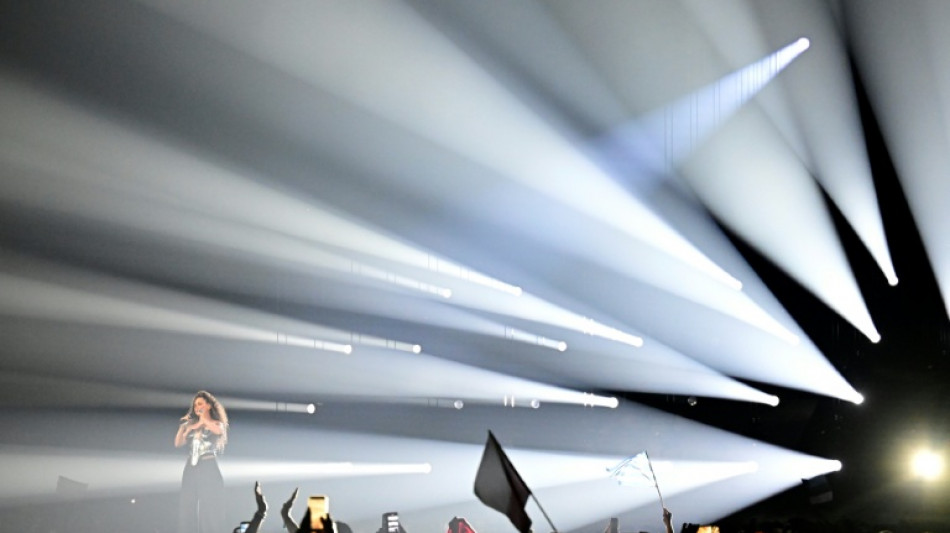
The Eurovision Song Contest's staging this year is inspired by grand Viennese opera, with more than 3,000 lights and lasers used to conjure up different visual worlds for all 35 performances.
Set designers also drew on Vienna's creative history and the mindset of artists like painter Gustav Klimt for this year's edition of the world's biggest live televised music event.
Eurovision is known for pulling out all the stops, but rather than "showing off" with even more expansive sets and backdrops, the creative brief was "something that feels Viennese and Austrian", stage designer Florian Wieder told reporters.
"We have a kind of opera, very theatrical approach this year, to make it feel unique and different.
"It's very traditional on one hand and it's also very modern on the other."
Between acts, viewers will hear bits of Wolfgang Amadeus Mozart's 1791 opera "The Magic Flute", along with the sound of an orchestra tuning up when artists prepare to take the stage at the Austrian capital's Wiener Stadthalle.
The design feel was also inspired by the groundbreaking Vienna Secession art movement of the late 1890s and early 1900s, of which Klimt was a part.
"What happened back then was a kind of a creative reset. And that was exactly what we were looking for," said Wieder, who has designed the Eurovision stage 10 times and has also created sets for U2, Ed Sheeran, Beyonce and Robbie Williams.
- Flames, fog, smoke and sparklers -
Acts representing 35 different countries take the stage across the two semi-finals and Saturday's grand final, with each seeking to connect with tens of millions of TV viewers in just three minutes.
"What we're trying to do is create a thousand different worlds for the different performances," said lighting designer Tim Routledge.
"It's about working out how to integrate and hide lighting all over the place."
"Effectively, without light, it's radio," he added.
Eurovision 2026 has nearly 200 special-effects machines including flames, fog, smoke, sparklers and multi-coloured pyrotechnics in pink, purple, yellow and gold.
The show is being shot on 28 live cameras and Routledge said the new cinematic-style cameras being used this year meant the performances were coming out in a different way on television.
"For me, some of the performances where we do less are the performances that really strike a chord... so smaller performances -- as opposed to flashing all three and a half thousand lights," he said.
- 'Less flashy-trashy' -
Last year's song contest in Basel, Switzerland, which reached 166 million viewers, was won by Austria's JJ with a performance entirely in monochrome.
"No one wants colour this year," said Routledge.
Britain and San Marino aside, "everyone's wanted quite sombre or pale, warm whites or cold whites".
As for why, he said: "There seems to be a lot of angst in music and a lot of emotion this year in a lot of the music. Maybe not so many up-tempo, fun songs as some years.
"Maybe it's a trend in creatives, and people want something a bit more pure and a bit less flashy-trashy, and they want something a little bit more theatrical."
With each dress rehearsal, Routledge said his team was constantly finding ways to improve the show, while countries were also making fresh requests.
"It is precision, fully to the frame of every single camera shot," he said.
"So we will carry on tweaking, mending, tidying and polishing all the way to Saturday night."
B.Sumairi--al-Hayat